

Background
Commercial diving vessels carry Kelly tubes (breathing air tubes) for the deep-sea divers’ air supply. These Kelly tubes can be up to 11 meters or longer in length and are kept at lower deck of the vessel. These Kelly tubes need to be inspected for fitness every five years for statutory certification.
Smaller size Kelly tubes are essential for Diving bells and Hyperbaric lifeboats.
Conventional certification techniques have been on-shore hydro testing or in-situ fine borescope inspection through neck nozzle of cylinders after depressurizing. Both methods are time and labour-intensive inspections. Due to expensive port/docking charges, the vessel owners have been looking for faster inspection methods, approved by class societies to reduce cost & time for these statutory Kelly tube inspections.
With advent of acoustic emission technology, now class societies (e.g. DNV-GL) accept in- situ, non-invasive acoustic emission inspection of pressurised Kelly tubes as alternative inspection technique for detecting corrosion and crack defects.
Job Overview
As per Client, their major concern was to detect corrosion in the Kelly tubes.
The first Acoustic Emission (AE) testing of pressurised Kelly Tubes was conducted in second half of 2018 by Arise Global Pte Ltd on board the diving vessel at Loyang Dock in Singapore.
- Acoustic Emission sensors were mounted along the Kelly tubes.
- Acoustic emission data was collected form each Kelly tube examined.
- Acoustic emission signal detection was performed with respect to the noisy ambient conditions.
- Data recorded during the examination was analysed using specially developed analysis procedure.
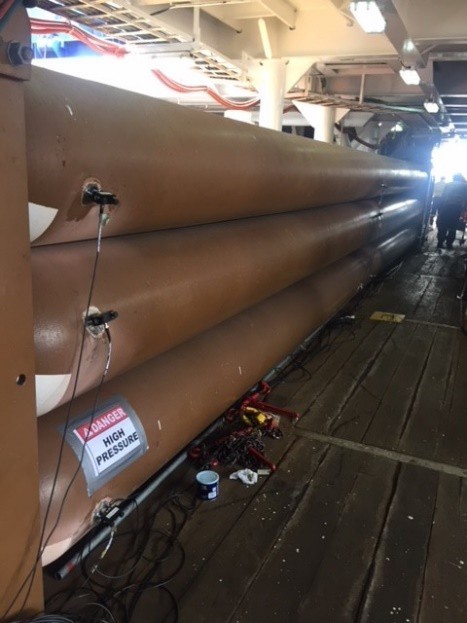
Inspection Equipment Details
| Item Name | Kelly Tubes |
| Built Year | 2011 |
| Material | Carbon Steel |
| Diameter | 0.56m |
| Minimum wall Thickness | 12.7mm |
| Circumference | 1.74m |
| Corrosion Allowance | 1mm |
| Length | 11.5m |
| Stored Medium | 12% oxygen; 88% helium |
| Capacity | 2466 Litres |
| Operating Temperature/ Pressure | Ambient / 200bar |
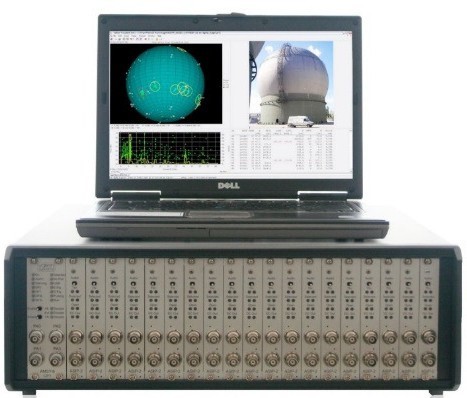
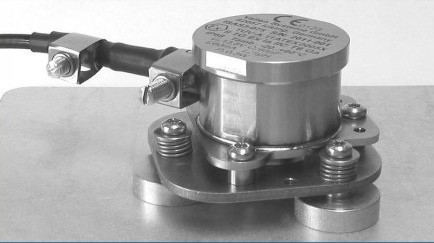
Testing Equipment Details
Acoustic Emission Inspection Results
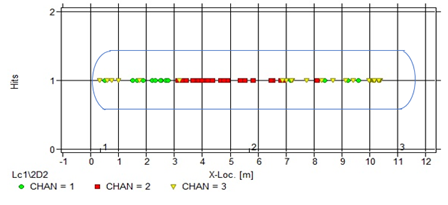
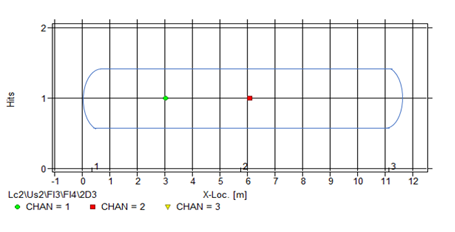
Source Localization Diagram for Kelly Tubes
Conclusion
Based on analysis of acoustic emission data, it was concluded that:
- Minor corrosion activities are detected around the circumference of the Kelly Tube, at lengths 3m and 6m respectively (refer Figure 5).
Recommendations
Based on the results and considering the age of the Kelly tubes, it was recommended to the client to:
- Carry out Acoustic Emission inspection within next 5 years unless; another NDT inspection (UT/others) of the tubes is carried out within this period.
- Subsequent Acoustic Emission inspection/s will provide an accurate measure of AE activity growth in Kelly Tubes.
The inspection was completed within two working days and vessel sailed next day after inspection. Final report was submitted within a week to client who gave us 10/10 performance grading.
